The Executive Alignment Framework™
Why strategy rarely fails in the boardroom—but so often fails during execution.
Every strategy begins with clarity
Inside the boardroom, the CEO and executive team understand the vision. Priorities have been debated. Trade-offs have been agreed. Strategic intent is clear.
Yet as organisations grow, something predictable begins to happen.
The strategy itself does not change.
The organisation's understanding of it does.
Every reporting layer introduces interpretation. Every operational pressure demands compromise. Every local culture adds variation. Every management handover loses a little context, a little clarity and a little confidence.
By the time strategic intent reaches the frontline, employees are often executing a version of the strategy that no longer resembles the one conceived in the boardroom.
This is not a failure of leadership.
It is a failure of organisational design.
Most organisations attempt to solve it by communicating more.
More emails.
More meetings.
More town halls.
More presentations.
But increasing the volume of communication does not strengthen the infrastructure through which strategic intent travels.
That requires a different approach.
Communication Is Infrastructure
At Steve Dickinson Advisory, we view communication differently.
Communication is not a soft skill.
It is organisational infrastructure.
Just as financial systems preserve financial integrity and quality systems preserve product integrity, communication systems must preserve executive intent.
When that infrastructure is weak, strategic alignment deteriorates.
When it is deliberately designed, strategy reaches every level of the organisation with far greater consistency.
That philosophy forms the foundation of The Executive Alignment Framework™.
The Four Principles of Executive Alignment
The Executive Alignment Framework™ is built upon four simple principles.
1. Strategy Fracture™
Strategy rarely fails because it is poorly conceived.
It fails because executive intent fractures as it passes through multiple organisational layers.
Every layer introduces interpretation.
The further strategy travels from the executive team, the greater the risk of inconsistency.
2. The Translation Burden™
Middle managers should lead.
Instead, many are forced to become translators.
Without sufficient context, they interpret strategy in different ways for different teams.
No organisation can achieve consistent execution when every manager is telling a slightly different story.
The objective is not to bypass managers.
It is to equip them.
3. Executive Alignment Infrastructure™
If misalignment is structural, the solution must also be structural.
Executive Alignment Infrastructure™ is the deliberate design of leadership communication systems that preserve executive intent from the boardroom to the frontline.
Rather than relying on fragmented communication channels, it creates a reliable architecture through which strategic intent travels with clarity, consistency and trust.
4. Continuous Executive Alignment
Alignment is not an event.
It is an organisational capability.
Every strategic initiative, acquisition, transformation programme and market change places new demands on leadership communication.
Organisations therefore require an ongoing discipline that continually strengthens executive alignment as the business evolves.
Applying the Framework
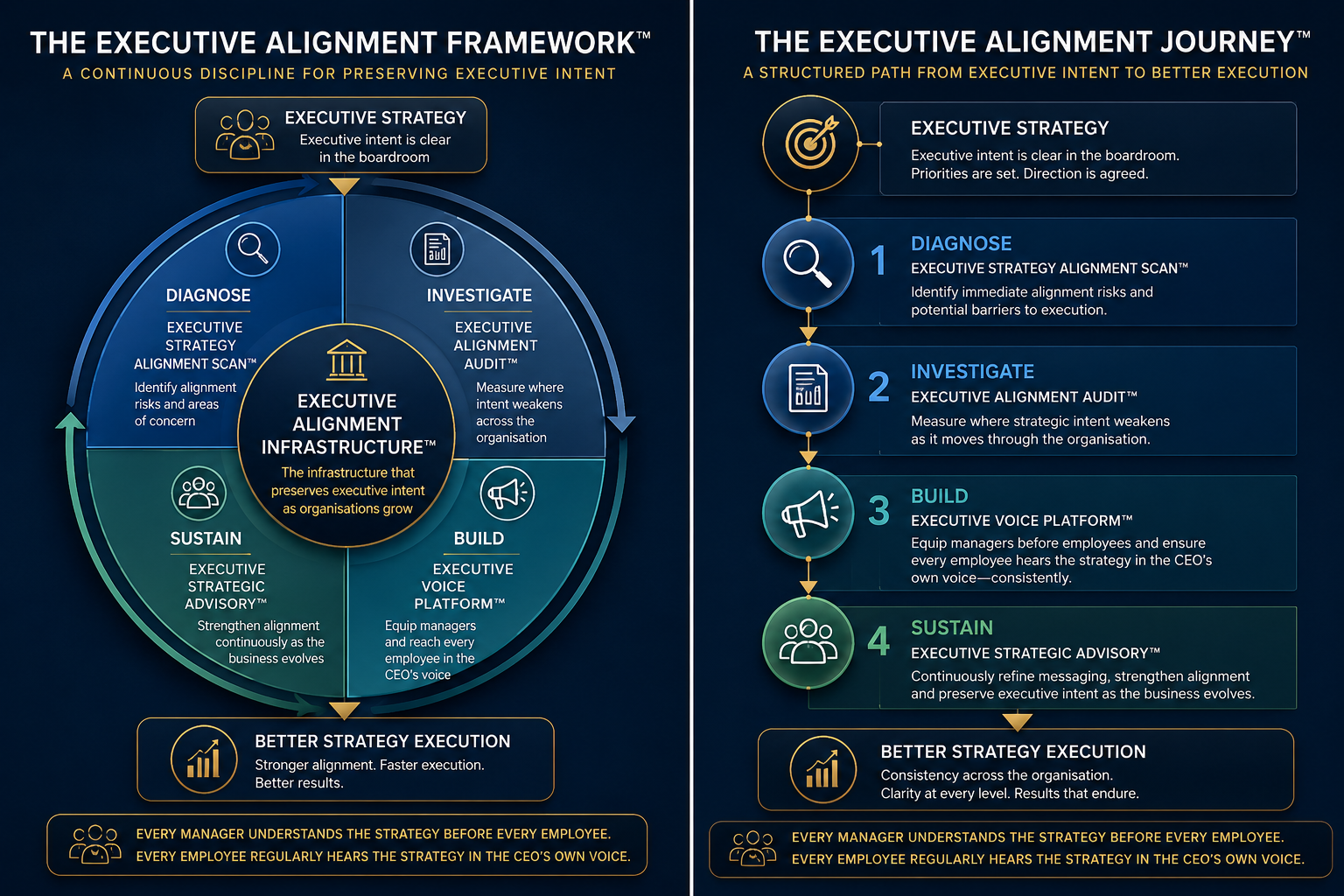
The Executive Alignment Framework™ is implemented through four progressive stages.
Diagnose
Executive Strategy Alignment Scan™
A rapid executive diagnostic that identifies immediate alignment risks before major strategic initiatives, restructures or executive communications.
Investigate
Executive Alignment Audit™
A comprehensive organisational assessment that measures exactly where strategic intent weakens between the executive team and the frontline.
The audit bypasses traditional organisational filters to reveal the true state of executive alignment across the business.
Build
Executive Voice Platform™
A secure executive communication infrastructure that enables every manager to understand strategic intent before every employee—and enables every employee to regularly hear the strategy in the CEO's own voice.
Rather than replacing existing communication channels, it strengthens them by preserving context, tone and intent.
Sustain
Executive Strategic Advisory™
Long-term strategic partnership with CEOs and executive teams to continually refine strategic messaging, strengthen leadership communication and preserve executive alignment as the organisation grows and changes.
The Outcome
The purpose of The Executive Alignment Framework™ is not better communication.
It is better execution.
When executive intent is preserved:
Managers lead with confidence rather than interpretation.
Employees understand not only what is changing, but why.
Rumours lose their influence because leadership becomes a consistent presence.
Strategic initiatives gain momentum faster.
Operational execution becomes more consistent across sites, regions and countries.
Executive alignment becomes an organisational capability rather than an aspiration.
Every Manager Before Every Employee
The Executive Alignment Framework™ is founded on one simple principle.
Every manager should understand the strategy before every employee. Every employee should regularly hear the strategy in the CEO's own voice.
When managers are equipped first, they become confident leaders rather than reluctant translators.
When employees hear directly from the CEO, strategic intent retains its tone, nuance and authenticity.
That is how executive intent survives the journey from the boardroom to the shop floor.
That is Executive Alignment.
Founder’s Note:
"After forty years leading multi-site manufacturing and industrial organisations across the UK and Europe, I kept encountering the same problem. Good strategies were failing—not because they were wrong, but because they were losing clarity as they travelled through increasingly complex organisations. The Executive Alignment Framework™ is the culmination of those observations. It is the management discipline I wish I had been taught as a divisional leader, and the one I now share with CEOs determined to preserve strategic intent as their organisations grow."
Steve Dickinson