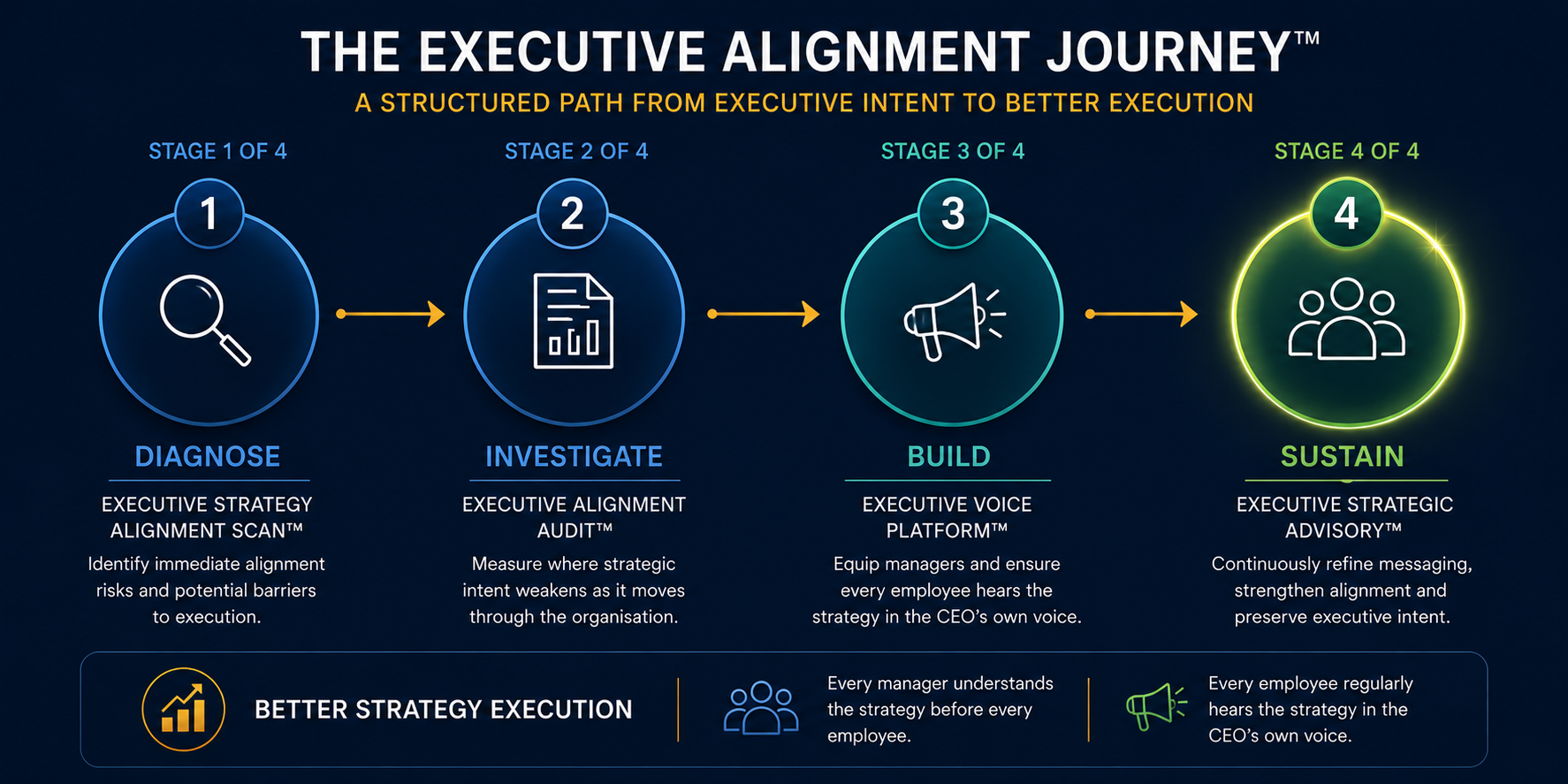
Stage 4: Sustain
Executive Strategic Advisory™
Executive Alignment Is Not a Project. It Is an Executive Discipline.
The Executive Alignment Journey™ does not end when new communication infrastructure has been implemented.
Organisations continue to evolve.
Strategies change.
Markets shift.
Leadership teams change.
Businesses acquire new operations.
Priorities are continually refined.
Each change places fresh demands on executive alignment.
Without ongoing stewardship, even well-designed communication systems gradually lose their effectiveness as new organisational realities emerge.
Executive alignment therefore requires continual attention—not because the original architecture was flawed, but because the organisation itself never stands still.
Why Sustaining Alignment Matters
Many organisations invest significant time and resources launching a new strategy.
Far fewer invest in preserving strategic clarity over the years that follow.
As priorities evolve, leadership language changes.
New executives introduce different perspectives.
Managers interpret emerging priorities in different ways.
Employees naturally begin asking familiar questions once again.
"What's really changing?"
"Why are we doing this?"
"How does this affect my team?"
Executive alignment is not maintained through occasional communication campaigns.
It is maintained through disciplined leadership.
A Trusted Executive Partner
Executive Strategic Advisory™ provides CEOs and executive teams with an ongoing strategic partnership focused on preserving executive intent throughout the organisation.
Rather than acting as an external communications consultant, I become an independent executive adviser whose role is to continually strengthen Executive Alignment Infrastructure™.
Together, we refine strategic messaging before major announcements.
We anticipate where misunderstanding is most likely to occur.
We equip managers with the context they need to lead confidently.
And we ensure that executive communication continues to support execution as the organisation evolves.
What the Advisory Relationship Includes
Every engagement is tailored to the organisation's needs, but typically includes:
Strategic messaging support for major organisational initiatives.
Preparation for CEO audio briefings and executive communications.
Executive sounding board for complex organisational challenges.
Ongoing review of Executive Alignment Infrastructure™.
Leadership communication coaching focused on preserving executive intent.
Periodic Executive Alignment Reviews to identify emerging risks before they become operational issues.
Guidance on maintaining managerial confidence during periods of change, growth or restructuring.
The relationship is deliberately flexible and structured around the pace of your organisation.
Some clients require support during periods of transformation.
Others choose a long-term advisory relationship as part of their executive governance.
Executive Alignment as a Leadership Capability
The strongest organisations do not treat executive alignment as a communication exercise.
They treat it as a core leadership capability.
Just as boards regularly review financial performance, operational risk and governance, executive alignment deserves the same ongoing attention.
When strategic intent remains consistent, organisations execute with greater confidence.
When leadership communication evolves deliberately rather than reactively, trust accumulates over time.
Executive alignment becomes embedded in the culture of the organisation.
A Bespoke Advisory Relationship
Every organisation is different.
Some require regular strategic support throughout the year.
Others seek guidance around specific transformation programmes, acquisitions or organisational change.
For this reason, Executive Strategic Advisory™ is offered on a customised retainer, designed around the scale, complexity and cadence of each organisation.
The objective is simple:
To provide CEOs and executive teams with experienced, independent strategic support whenever executive alignment matters most.
The Outcome
The Executive Alignment Journey™ concludes with something far more valuable than improved communication.
It creates an organisation where strategic intent remains clear as the business grows.
Managers lead with confidence because they understand the strategy before their teams.
Employees trust leadership because they hear consistent messages supported by authentic executive presence.
Communication ceases to be a recurring organisational problem.
It becomes part of the infrastructure that enables consistent execution.
Executive Alignment Infrastructure™ becomes a permanent organisational capability.
The Journey Never Really Ends
The four stages of The Executive Alignment Journey™ provide a structured path:
Diagnose.
Investigate.
Build.
Sustain.
But executive alignment is not a destination.
It is a discipline.
The organisations that sustain alignment over many years are those that recognise communication is infrastructure—not a soft skill—and invest in preserving executive intent with the same discipline they apply to every other critical business capability.
Founder's Perspective
“Throughout four decades of leading industrial organisations, I discovered that the most successful leadership teams were not necessarily those with the best strategies.
They were the teams that continually revisited, refined and reinforced their strategic intent as their organisations evolved.
That observation shaped Executive Strategic Advisory™.
My role is not to become part of your management structure.
It is to remain an independent executive adviser who helps you preserve clarity, strengthen alignment and ensure that your strategy continues to travel through your organisation with the fidelity it deserves.
Because strategy is only as powerful as the organisation's ability to understand it.”
Steve Dickinson